01What race walking is under the rules
World Athletics rule TR 54.2 defines race walking as a progression of steps in which the walker stays in contact with the ground, so that no loss of contact is visible to the human eye. The advancing leg must be straightened, i.e. not bent at the knee, from the moment of first contact with the ground until the vertical upright position.
So there are two offences: loss of contact and bent knee. Judges assess with the naked eye only, each one independently.
02The yellow paddles: a caution
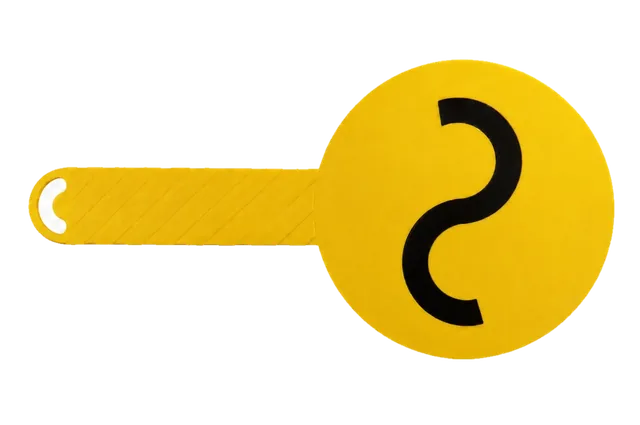
When a judge is not completely satisfied that an athlete is complying with the rule, they should, where possible, show the athlete a yellow paddle with the symbol of the offence on each side (TR 54.5):
- ~ — loss of contact;
- > (or <) — bent knee. The rule does not fix which way the symbol points.
The same judge cannot show a second yellow paddle to the same athlete for the same offence. A yellow paddle is not a penalty: it gives the athlete the chance to correct their technique.
03The red card
When a judge sees a clear offence, they send a red card to the Chief Judge with their judge number, the athlete’s bib, the offence and the time it was written (TR 54.6). The red card is not shown to the athlete: it is a written proposal for disqualification and takes effect when it is written.
Athletes find out from the posting board on the course and near the finish, which shows how many red cards each athlete has received and for which offence (TR 54.7.7).
04The red paddle: notice of disqualification
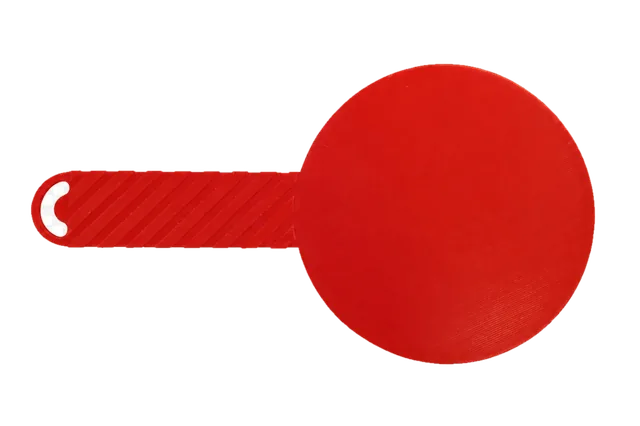
A disqualification is notified to the athlete by the Chief Judge or a Chief Judge’s Assistant showing a red paddle (TR 54.7.1). This happens when the athlete receives three red cards from three different judges and the competition does not use a penalty zone or, with a penalty zone, at the fourth red card.
In World Rankings competitions the Chief Judge can also disqualify an athlete in the last 100 m when their mode of progression obviously fails to comply with the rule: the red paddle is then shown as soon as possible after the athlete finishes (TR 54.4.1).
05The penalty zone and the 2026 penalty times
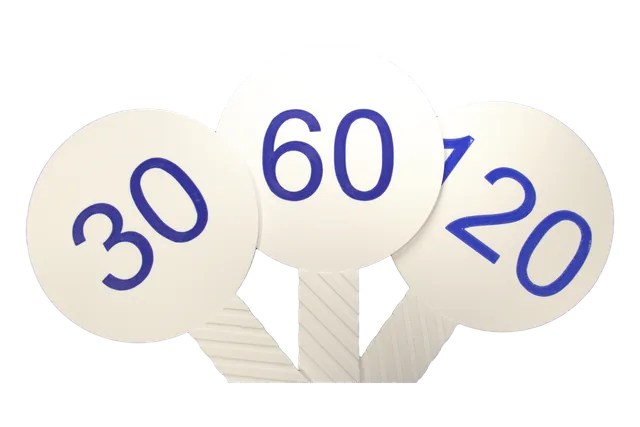
Where the competition regulations provide for it (TR 54.7.3), at the third red card the athlete is not disqualified but must enter the penalty zone and stay there for a time that depends on the race distance. Then they rejoin the race. A fourth red card, from a fourth different judge, leads to disqualification (TR 54.7.5).
| Races up to and including | Time in the penalty zone | Paddle |
|---|---|---|
| 5000 m / 5 km | 30 seconds | 30″ |
| 10,000 m / 10 km | 1 minute | 60″ |
| Half marathon | 2 minutes | 120″ |
| 30,000 m / 30 km | 3 minutes | 180″ |
| Marathon | 4 minutes | 240″ |
| 50,000 m / 50 km | 5 minutes | 300″ |
Note: until 31 December 2025 the table was different (for example 20 km = 2 minutes, 35 km = 3.5 minutes). Many documents online still show the old values.
The Chief Judge or an assistant directs the athlete into the zone and shows the time on a paddle with the penalty time on both sides; an official times the stop and gives a warning 10 seconds before the end. An athlete who fails to enter the zone, or leaves early, is disqualified by the Referee. If the third red card comes when the athlete can no longer enter the zone, the penalty time is added to their finishing time (TR 54.7.4).
06How many judges work at a race walk
On the road there are normally 6 to 9 judges, on the track normally 6, Chief Judge included (TR 54.3). They work with the recorder, the posting board operator and, where needed, one or two penalty zone officials. At major international events there can be no more than one judge per national federation.
07How to become a race walking judge
You start as a judge with your national federation, which runs the courses and exams; race walking judging is a specialisation within the officials’ path. At international level World Athletics recognises Bronze, Silver and Gold Level Race Walking Judges, and applications go through the national federations.
08The terms in other languages
| English | Italiano | Español | Français | Deutsch |
|---|---|---|---|---|
| yellow paddle | paletta gialla | paleta amarilla | panneau jaune | gelbe Kelle |
| red paddle | paletta rossa | paleta roja | panneau rouge | rote Kelle |
| red card | cartellino rosso | tarjeta roja | carton rouge | rote Karte |
| Chief Judge | Giudice Capo | Juez Jefe | chef-juge | Gehrichterobmann |
| penalty zone | penalty zone | Área de Penalización | zone de pénalité | Strafzone |
| loss of contact | perdita di contatto | pérdida de contacto | perte de contact | Kontaktverlust |
| bent knee | ginocchio piegato | flexión de rodilla | genou plié | gebeugtes Knie |
09Sources
- World Athletics, Book of Rules, Book C – C2.1 Competition & Technical Rules, 2026 edition, rule TR 54.
- FIDAL (Italy), judges’ group: International Technical Rules 2024 and Application Provisions 2025.
- RFEA (Spain), National Judges’ Committee: Race Walking Jury Guide 2023.
RWPaddle paddles for race walking judges
Race walking kit with the two yellow paddles, the red paddle and the case; penalty kit with time paddles matching the 2026 rule. 3D printed in Italy.
This is an explanatory guide, not an official text: at a competition the World Athletics rules and those of your federation apply.